

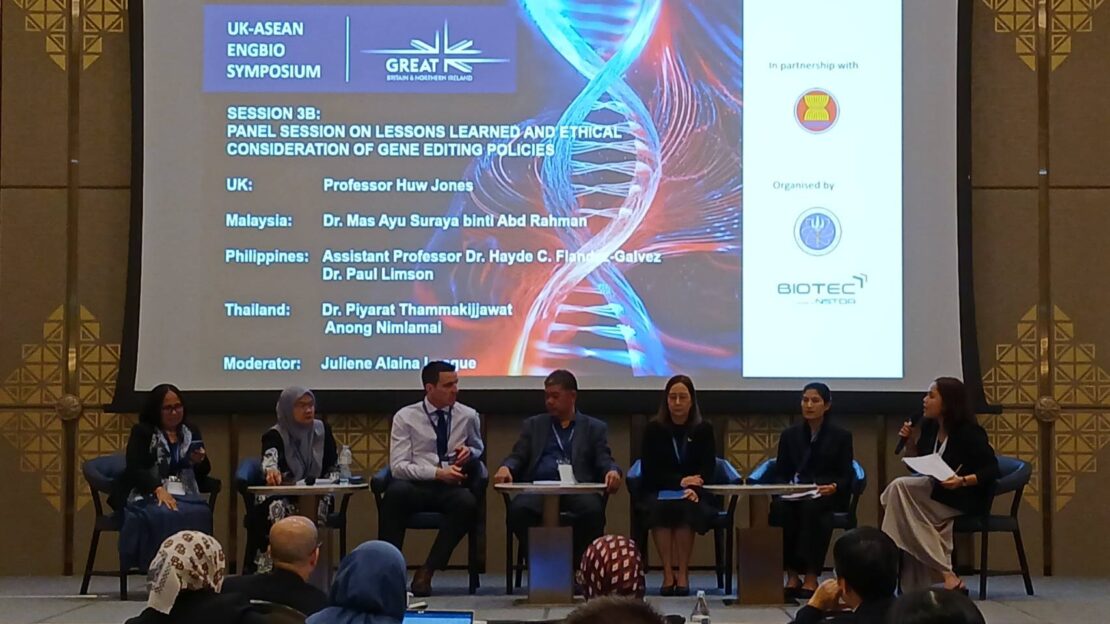

Recently Dr. Huw Jones was invited by the British Agricultural Attache to Thailand, Rickie Jennings to attend this important symposium
In November the UK Government hosted an Engineering Biology Symposium in Bangkok, Thailand aimed at ‘Fostering UK-ASEAN Partnerships in responsible Research and Innovation in Engineering Biology. ASEAN is the association of South-East Asia Nations which includes 11 countries that combined host over 686 million people.
With a keynote address on day one from Professor Chris Johnson (Chief Scientific Adviser to DSIT), the event aimed to showcase UK and ASEAN expertise and experiences in harnessing innovation across a range of areas from human medicine to agriculture and food, whilst considering key building blocks such as establishing standards, genome engineering and synthetic biology.
The keynote presentation on day two was given by Dr Huw Jones (a member of the UK governments ACRE and UKGLE committee’s) who showcased the UK’s expertise in genome editing application in animal and plants, along with an industry perspective on the opportunities and challenges that lay ahead if we are to harnessing effectively the potential the technology to offers. Huw also outlined the UK’s recent experience in developing a regulatory framework (which came into effect for applications in plant on the 14th of November) to a support the Precision Breeding Act. Huw also joined a panel discussion on the ‘Lessons learnt and ethical consideration of genome editing policies’.
There was already a range of existing activity across the ASEAN (particularly related to crop breeding) aimed at exploring the potential benefits that could be realized by adopting the technology. Some counties (such as the Philippines) have already established a regulatory framework for approval of applications in plants.
There was a strong interest from across many ASEAN countries to collaborating with the UK to help drive benefits capture. How those interests can be best stimulated and nurtured will need to be worked out, but the symposium offered a strong platform from which to progress discussions.